Decanter centrifuges have become a standard technology for sludge dewatering in modern wastewater treatment plants. Among the various models available, the GN Separation 14-inch (GNLW364-VFD) decanter centrifuge has gained notable traction in overseas markets, particularly for municipal and industrial sludge treatment applications. This article provides a technical overview of how this equipment functions and why it is suited for international wastewater projects.
The primary role of a sludge dewatering centrifuge is solid-liquid separation. In a wastewater treatment plant, sludge generated from primary and secondary settling tanks typically contains more than 95% water. Direct disposal of this sludge is impractical and costly due to its volume. The centrifuge reduces the water content, producing a cake that is easier to handle, transport, and dispose of, while the separated liquid (centrate) is returned to the treatment process for further clarification. The GN 14-inch model is designed to handle a throughput that suits medium-to-large scale plants, typically processing 20 to 50 cubic meters per hour depending on sludge type.
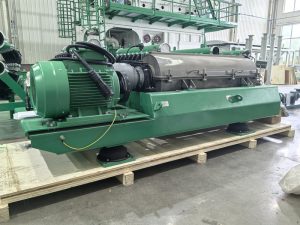
The operational principle is based on differential sedimentation. The equipment consists of a rotating bowl and an internal screw conveyor (scroll) that rotates at a slightly different speed.
- Feed and Acceleration: Sludge is pumped into the centrifuge through a stationary feed tube. It enters the rotating bowl assembly, where it is gently accelerated to avoid breaking the flocs that have been formed by polymer addition upstream.
- Sedimentation: Inside the cylindrical-conical bowl, the mixture is subjected to a centrifugal force that can exceed 3000 times gravity (up to 3000 RPM for this model). Under this force, suspended solids, which have a higher density than water, are rapidly deposited against the bowl wall.
- Conveyance and Dewatering: The screw conveyor, driven by a planetary gearbox (differential), rotates slightly slower (or faster) than the bowl. This relative motion pushes the settled solids toward the conical end (the beach) of the bowl. As the solids travel up the beach, they are exposed to the open air and further drainage occurs before they exit through discharge ports.
- Liquid Discharge: The clarified liquid, now free of suspended solids, overflows through adjustable weir plates at the opposite end of the bowl. The weir position controls the liquid pool depth, which is a critical parameter for optimizing cake dryness and centrate clarity.
The GNLW364-VFD model incorporates several features that address the specific challenges of overseas installations:
- Material Selection: The bowl is manufactured from Duplex Stainless Steel 2205. This material offers high tensile strength and excellent resistance to chloride-induced stress corrosion cracking, making it suitable for sludges with high salinity or aggressive chemical content. The scroll blades are protected with tungsten carbide tiles or a wear-resistant coating to withstand abrasive grit often present in raw sewage.
- Variable Frequency Drive (VFD) Control: The “VFD” in the model name indicates that the main motor speed is adjustable. This allows the operator to fine-tune the centrifugal force to match the specific sludge characteristics (e.g., biological sludge vs. chemical sludge). A separate back-drive system controls the differential speed between the bowl and the scroll. Precise control of this differential speed is essential for achieving consistent cake dryness without overloading the conveyor.
- Compact Footprint: Compared to belt presses or filter presses, a centrifuge occupies significantly less floor space. For overseas projects where real estate is expensive or existing infrastructure is being retrofitted, this is a decisive advantage.
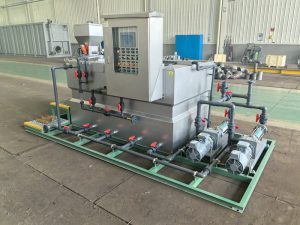
Successful operation requires proper integration with the upstream process. The centrifuge must be paired with a polymer dosing unit for flocculation. The performance is highly dependent on the polymer type and mixing energy. For overseas projects, GN Separation provides complete process engineering support, including the design of the feed pump, flocculant preparation system, and cake discharge conveyor.
In summary, the GN 14-inch decanter centrifuge serves as a robust and efficient solution for sludge volume reduction in overseas wastewater treatment plants. Its high centrifugal force, durable construction, and precise speed control enable operators to achieve dry solids content typically in the range of 20% to 30%, depending on the sludge type. This reduces disposal costs and contributes to the overall sustainability of the treatment facility