Big Bowl Decanter Centrifuge for Overseas Paper Mill Wastewater Treatment

Large-drum decanter centrifuges are widely used in overseas paper mills for wastewater treatment, primarily due to their high efficiency, continuous operation, and robust performance in solid-liquid separation. This equipment plays a crucial role in dewatering sludge and recovering solids from paper mill effluent, meeting stringent environmental regulations while optimizing operational costs.

The operational principle of a decanter centrifuge relies on centrifugal force to separate solids from liquids. The machine consists of a horizontally mounted cylindrical-conical bowl, known as the drum, which rotates at high speed. Inside this drum, a screw conveyor rotates at a slightly different speed. When wastewater slurry containing suspended solids—such as fibers, fillers, biological sludge, and chemical residues—is fed into the rotating drum, the high centrifugal force causes denser solid particles to settle against the drum wall. The screw conveyor continuously moves these settled solids toward the conical end for discharge, while the clarified liquid flows toward the wider end and is discharged through an overflow weir. This continuous, automated process eliminates the need for batch processing, significantly increasing throughput and reducing manual intervention.
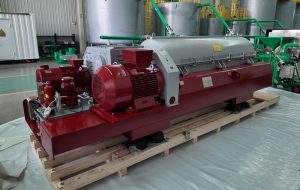
In overseas paper mills, wastewater composition is often complex, with high levels of fine fibers, calcium carbonate, clay, and organic matter. This makes dewatering challenging due to high viscosity, abrasiveness, and potential for clogging. Large-drum decanter centrifuges, typically with drum diameters exceeding 600 mm, are specifically designed to handle such demanding conditions. Their large processing volume allows for high flow rates, often reaching hundreds of cubic meters per hour, making them suitable for large-scale paper mills with daily wastewater volumes of 10,000 to 50,000 cubic meters.

Key performance advantages of these centrifuges in paper mill applications include high separation efficiency, durability, and adaptability. The drum and screw are often constructed from corrosion-resistant materials such as duplex stainless steel, which withstands the aggressive chemical environment of paper wastewater. Critical wear parts, like the solid discharge ports and screw flights, are protected with tungsten carbide or other hard alloys to extend service life when processing abrasive fillers. Advanced models feature variable frequency drives (VFDs) that allow operators to adjust bowl speed and differential speed independently, optimizing performance based on feed consistency and desired cake dryness. This control typically results in dewatered sludge with a solids content of 15% to 25% (or 75% to 85% moisture content), reducing sludge volume and lowering disposal and transportation costs.
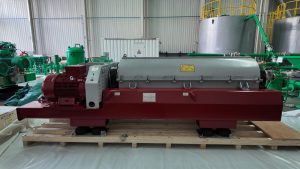
For overseas installations, reliability and ease of maintenance are critical considerations. Many paper mills are located in regions with limited technical support or harsh climates. Manufacturers address this by designing centrifuges with modular components, easy-access maintenance points, and remote monitoring capabilities. Integration with plant Distributed Control Systems (DCS) enables real-time performance tracking, predictive maintenance alerts, and troubleshooting assistance from off-site experts, minimizing downtime and reducing reliance on local specialized labor.

From an economic perspective, large-drum decanter centrifuges offer significant operational savings compared to traditional dewatering equipment like belt presses or plate-and-frame filter presses. Their continuous operation reduces labor requirements, while efficient dewatering lowers energy consumption per unit of processed sludge. Reduced polymer (flocculant) consumption, due to optimized mixing and separation zones within the centrifuge, further cuts operational expenses. Case studies from mills in Southeast Asia, Europe, and North America show that replacing older dewatering systems with modern decanter centrifuges can reduce overall operating costs by 30% to 40%, with investment payback periods often under two years.

Environmental compliance is another major driver for adoption. Overseas paper mills must meet local discharge limits for suspended solids and chemical oxygen demand (COD). By efficiently removing fine solids and organic materials, decanter centrifuges produce a clearer effluent that can be more easily treated in subsequent biological or chemical stages, or sometimes discharged directly after meeting regulatory standards. The drier sludge cake is also easier to handle, transport, and dispose of in landfills or incineration facilities, reducing environmental liability.

In summary, large-drum decanter centrifuges serve as a core component in modern overseas paper mill wastewater treatment systems. Their ability to provide continuous, high-capacity, and efficient solid-liquid separation addresses the key challenges of large-scale paper production: managing waste streams, controlling costs, and maintaining regulatory compliance. As global paper industries continue to emphasize sustainability and operational excellence, the role of this technology is expected to grow, supported by ongoing advancements in materials, automation, and energy-efficient design.
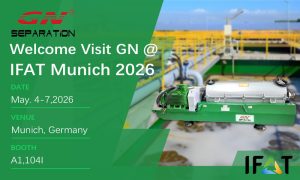
GN will Show at IFAT Munich 2026 in Germany this May

GN Company will participate in IFAT Munich 2026, the world’s leading trade fair for water, sewage, waste, and raw materials management. The event will take place from May 4 to May 7, 2026, at the Messe München exhibition center in Munich, Germany. Our booth will be located at A1, 104I. This participation represents a strategic step in our international expansion and aligns with our commitment to showcasing advanced environmental solutions on a global stage.

IFAT Munich is a premier event with a history spanning over six decades, organized by Messe München. It serves as a central hub for industry professionals, policymakers, and technology providers from across the globe. The 2026 edition is expected to host over 2,000 exhibitors and attract more than 100,000 professional visitors from more than 100 countries. The exhibition covers a comprehensive range of sectors, including water and wastewater treatment, solid waste management, recycling technologies, resource recovery, and digital solutions for environmental management. For GN, this provides an optimal platform to engage with international clients, observe emerging trends, and establish partnerships within the global environmental technology market.

Our focus at IFAT 2026 will be to present our core competencies and innovative systems in municipal and environmental engineering. This includes solutions for solid waste processing, sludge treatment, decentralized waste collection systems, and smart management platforms for urban services. We will demonstrate our integrated approach to projects, which combines practical engineering with sustainable operational models. The exhibition allows us to directly present our technical capabilities to European and international buyers, engineering firms, and municipal authorities who are seeking reliable and efficient environmental infrastructure solutions.

The global environmental sector is undergoing significant transformation, driven by stricter regulations, circular economy principles, and digitalization. Key trends such as high-value material recovery, energy-efficient wastewater processes, and IoT-based monitoring systems are reshaping industry standards. IFAT 2026 will feature dedicated zones and forums addressing these developments, including smart environmental technologies and circular economy innovations. Our participation enables us to align our R&D direction with these international trends, gain insights into EU regulatory frameworks, and identify potential areas for technological collaboration or adaptation.

From a business perspective, attending IFAT supports our strategic objective of expanding beyond regional operations. While we maintain a strong project base in domestic markets, international exposure is essential for long-term growth. The exhibition facilitates direct engagement with potential distributors, partners, and clients in Europe and other regions. It also offers a valuable opportunity to assess competing technologies, understand market expectations, and refine our product offerings to meet diverse international requirements. Furthermore, it strengthens our brand recognition as a competent provider of environmental solutions capable of operating in varied regulatory and operational contexts.

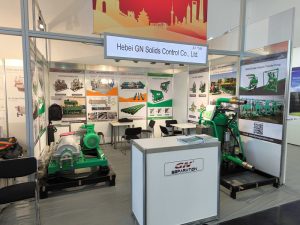
In preparation for the exhibition, we will organize our booth to effectively communicate our key projects and technological strengths. We plan to display operational models, case studies, and performance data from our implemented systems. Our technical representatives will be available for detailed discussions with visitors regarding system specifications, adaptability, and operational support. We aim to initiate concrete dialogues that could lead to partnerships, licensing agreements, or direct project inquiries in overseas markets.

Participation in IFAT Munich 2026 is a calculated investment in our international business development. It provides a concentrated venue for market entry, competitor analysis, and technology benchmarking. The connections made and intelligence gathered during the event will inform our strategic planning for the coming years, particularly regarding product development for international standards and exploration of new geographic markets. We anticipate that this engagement will contribute significantly to our growth as a provider of environmental solutions with global relevance.

We invite all professional visitors attending IFAT Munich 2026 to visit our booth at A1, 104I to learn more about our projects, discuss potential collaborations, and explore how our solutions can address specific environmental management challenges. Our team looks forward to productive exchanges and to contributing to the international dialogue on sustainable environmental infrastructure.

GN Solids Mena in UAE to Support GN Middle East and North Africa Business

The establishment of GN Solids Control UAE Middle East Company marks a strategic expansion into the Middle East and North Africa (MENA) region. This move is a direct response to the accelerating energy transition and large-scale digital infrastructure development across MENA. Nations like Saudi Arabia and the UAE, driven by national visions such as Saudi Vision 2030 and the UAE Green Agenda, are actively modernizing their power grids, integrating renewable energy, and demanding higher levels of operational safety and efficiency. GN Solids entry into this market positions the company to address these evolving needs through its portfolio of intelligent power operation and maintenance solutions.

Strategically headquartered in the UAE, the new entity leverages the country’s role as a stable, well-connected commercial and logistical hub for the broader region. The UAE offers a mature ecosystem of international business services, favorable regulatory frameworks within its free zones, and serves as a gateway to key economies including Saudi Arabia, Qatar, Egypt, and Morocco. This location enables efficient market access and the ability to build a localized operational footprint.

The core driver for GN Solid’s solutions in MENA is the region’s shift from traditional, manual grid maintenance towards automation and intelligence. High summer temperatures place extreme demand on power networks, making reliability paramount. Traditional live-line working carries inherent safety risks and can be slow. GN Solids technologies, including robotic live-line work systems, unmanned aerial vehicle (UAV) inspection platforms, and AI-assisted fault diagnosis, offer a pathway to safer, faster, and more predictable grid maintenance. The company’s approach is not merely equipment sales but a comprehensive “technology + service + localized operation” model, providing tailored solutions for utility companies and large industrial users.

GN Solid’s market entry is built on prior engagement and a clear localization strategy. Throughout 2025, the company participated in regional industry forums and initiated dialogues with potential partners, including local utilities, engineering contractors, and investment bodies. This groundwork has provided critical insights into local technical standards, procurement processes, and specific project pipelines. Initial cooperation agreements have been reached, focusing on pilot projects for smart maintenance systems, laying a foundation for full-scale deployment.

The localization model mirrors successful strategies employed by other international technology firms in the region. It emphasizes forming local partnerships, integrating into existing service networks, and building a team with regional expertise. The UAE’s robust professional services sector will facilitate this, assisting with company setup, compliance, and talent acquisition. Recruiting local engineers and project managers with Arabic language skills and knowledge of MENA’s power sector will be crucial for operational success and cultural alignment.

Furthermore, the region’s strong commitment to renewable energy creates synergistic opportunities. Major solar and wind projects across the Gulf and North Africa require advanced monitoring and maintenance systems capable of operating in harsh environments like deserts. GN Solid’s robotic and UAV-based solutions are ideally suited for the routine inspection and maintenance of these distributed renewable assets, filling a technical gap in the new energy landscape.

The establishment of the UAE Middle East Company represents an evolution in how Chinese technology firms engage with global markets. Moving beyond traditional engineering or equipment export models, GN Solids Control exemplifies a shift towards exporting integrated, high-value technological solutions and building long-term service ecosystems. This enhances the company’s position in the global value chain and contributes to the international influence of Chinese technical standards in the power sector.

In summary, the launch of GN Solid’s UAE Middle East Company is a calculated step to capture growth in a dynamic and strategically important region. By establishing a local hub, the company aims to deliver its intelligent O&M solutions effectively, adapt to regional requirements, and build lasting partnerships. This initiative positions GN Solids Control  not just as a supplier, but as a potential leading service provider in the MENA region’s power modernization journey, setting a benchmark for the global expansion of specialized Chinese technology.