The large bowl diameter delivers high centrifugal force and big solids-handling capacity, while the long cylindrical section improves clarification. The result: higher dry solids content in the cake and clearer centrate, even with variable sludge quality.
How the System Works
Conditioned sludge is pumped into the rotating bowl through a stationary feed tube. Centrifugal force pushes heavier solids to the bowl wall, while clarified liquid moves inward and overflows through adjustable weir plates. A slowly differentiating screw conveyor scrolls the dewatered cake toward the conical discharge end.
Because the process is fully continuous, there are no filter cloths or belts to replace. This eliminates batch downtime, reduces labor, and simplifies operation for overseas plants with limited maintenance crews.
For fine or diffuse sludge (activated sludge, DAF sludge, digested sludge), the centrifuge is paired with a GN automatic polymer dosing unit. Proper flocculation before centrifugation is often the key to stable cake dryness and low polymer consumption.
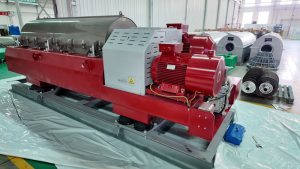
Built for Harsh WWTP Conditions
Overseas wastewater streams are rarely uniform. GN addresses this with engineering details that extend service life:
• Duplex stainless steel bowl (SS2205/SS2304) by centrifugal casting—high corrosion resistance vs. SUS304/316
• CNC-formed screw flights with wear-resistant alloy protection
• Tungsten carbide sleeves at solids discharge ports
• Adjustable weir plates to balance cake dryness vs. centrate clarity
• SKF bearings with automatic lubrication option
• VFD + PLC + HMI control with real-time monitoring of speed, vibration, temperature, torque, and current
Safety interlocks automatically respond to overload, blockage, or abnormal vibration—critical for unattended or remote-site operation.
Integrated Package for Export Projects
For overseas WWTPs, GN usually supplies more than a standalone centrifuge. A typical dewatering skid includes:
1. Sludge feed pump system
2. Polymer preparation and dosing unit
3. GNLW654 decanter centrifuge
4. PLC/VFD control cabinet (optional ATEX/IECEx)
5. Centrate collection and cake discharge chutes
6. Piping, platform, and instrumentation
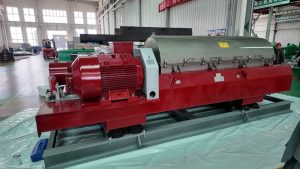
This turnkey layout reduces site installation time, supports containerized shipping, and helps EPCs meet local electrical and environmental standards.
Performance and Commercial Value
In field applications, the 650 mm centrifuge helps plants achieve:
• Drier sludge cake → lower volume and haulage cost
• Clearer centrate → easier downstream biological treatment
• Continuous 24/7 operation → stable plant throughput
• Lower lifecycle cost vs. belt press in abrasive sludges
• Reduced manual cleaning and spare-part dependency
For municipal sewage, industrial effluent, paper mill waste, or chemical sludge, the same machine platform can be tuned by differential speed, pool depth, and polymer recipe.
Proven Overseas Track Record
GN has commissioned GNLW654-class units for international clients with local partner support—including a municipal WWTP project in France where the equipment met design expectations on cake dryness, centrate quality, and running stability. Similar big-bowl packages have been delivered to South America and other regions for mud, sludge, and wastewater dewatering.
The GN 650mm diameter bowl sludge dewatering centrifuge is not just a bigger machine—it is a complete, export-ready separation solution. With high G-force performance, wear-resistant construction, intelligent control, and flexible system integration, it helps overseas WWTPs cut sludge volume, control disposal cost, and stay compliant with tightening discharge rules.
For municipal operators and EPC contractors evaluating dewatering upgrades, the GNLW654 offers a balanced combination of capacity, reliability, and lifecycle economy.
Want the full technical datasheet, sludge pilot-test procedure, or a tailored WWTP configuration? Contact GN Separation to discuss your feed profile and project site.